
The steel bar manufacturing process turns raw steel into the ribbed reinforcement bars (saria) used in every concrete building. In Pakistan, most mills make rebar by melting steel scrap into billets and then hot rolling those billets into bars. This guide walks through each step, from raw material to the finished, tested bundle, and explains what each step means for quality.
Overview of the Process
- Raw material selection
- Melting and refining
- Continuous casting into billets
- Reheating the billets
- Hot rolling into bars
- Quenching and self-tempering (TMT)
- Cooling, cutting and bundling
- Testing and quality control
1. Raw Material Selection
Most Pakistani rebar starts as steel scrap: old machinery, structural steel, ship-breaking steel and other recycled metal. Good mills sort and inspect scrap carefully, because dirt, non-ferrous metals and unknown alloys all affect the final chemistry. In addition, some mills buy ready-made billets instead of melting their own.
2. Melting and Refining
First, the mill melts the scrap in an electric furnace, usually an induction furnace or an electric arc furnace. Next, it refines the liquid steel: a spectrometer tests samples, and the melt shop adds alloying elements to bring carbon, manganese and other elements into the right range. Controlling this chemistry is what makes the steel strong, ductile and weldable.
3. Continuous Casting into Billets
The casting machine then pours the liquid steel into a water-cooled mould, where it solidifies into a long square bar called a billet. After that, a cutter splits the billet into set lengths. Clean casting with few internal defects is the foundation of a good bar.
4. Reheating the Billets
Before rolling, a reheating furnace heats the billets to roughly 1,100 to 1,200 °C. At this temperature the steel is soft enough to be shaped. Even heating matters, because cold spots lead to uneven bars.
5. Hot Rolling into Bars
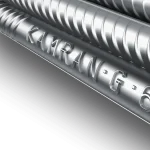
Next, the hot billet passes through a series of rolling stands. Each stand squeezes it thinner and longer, until it reaches the final diameter. Finally, the last stands cut the ribs (deformations) into the surface. These ribs lock the bar into the concrete. At the same time, the rolls print the manufacturer’s marks and the grade mark onto the bar.
6. Quenching and Self-Tempering (TMT)
As the bar leaves the last stand, many mills pass it through a water-quenching box. The surface cools very quickly and becomes hard, while the core stays hot. After that, heat from the core tempers the outer layer. The result, often called a TMT or QST bar, has a strong outer layer and a ductile core. For more, read TMT vs cold twisted steel bars.
7. Cooling, Cutting and Bundling
After quenching, the bars cool evenly on a cooling bed. Then workers cut them to standard lengths, usually 12 metres, and count, bundle and tag them with the size, grade and batch number.
8. Testing and Quality Control
Before the bars leave the mill, the laboratory tests samples from each batch:
- Chemical analysis to confirm the steel’s composition.
- Tensile test to measure yield strength, tensile strength and elongation.
- Bend test to check that the bar bends without cracking.
- Weight and dimension checks against the standard.
As a result, these figures appear on the mill test certificate, which buyers should always ask for. See how to test steel bar quality for details.
How the Process Affects Quality
| Step | What can go wrong | Effect on the bar |
| Scrap selection | Dirty or mixed scrap | Wrong chemistry, brittle steel |
| Melting and refining | Poor chemistry control | Low strength or poor ductility |
| Casting | Internal defects in billets | Weak spots, cracks when bent |
| Rolling | Poor roll setting | Underweight bars, weak ribs |
| Quenching | Uneven cooling | Inconsistent strength along the bar |
For this reason, bars from untested sources can look normal but fail on site. Read about common defects in steel bars.
To see how the industry works today, read our guide to steel mills in Pakistan.
Steel Bars from Kamran Steel
Kamran Steel has manufactured deformed steel bars in Lahore since 1984. We roll our bars from our own steel billets at our factory on Sheikhupura Road, and supply Grade 40 and Grade 60 bars to ASTM A615 in sizes from 10 mm to 36 mm. See our products or check today’s steel rate in Pakistan.
For a closer look at our mill, see the Kamran Steel process page. Testing at each stage is covered on our quality assurance page.
Related reading: Different Grades of Steel Bars · Advantages of TMT Bars · Why Steel Bar Quality Matters · Future of Steel Manufacturing in Pakistan: Innovations & Trends · Evolution of Steel Bar Mills in Pakistan: A Journey of Industrial Growth