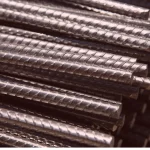
A 12-metre bar is rarely long enough for a whole beam, column or slab, so two bars are overlapped and tied together. That overlap is the lap length (also called overlap or splice length). If the lap is too short, the bars can pull apart under load; if it is longer than needed, you waste saria. This guide explains how lap length is worked out and gives a table in millimetres for common bar sizes.

Always follow your structural drawings. Lap lengths depend on concrete strength, steel grade, bar position and earthquake detailing. The figures below show how the code calculation works; your engineer’s drawing is the final word.
Lap Length vs Development Length
- Development length (Ld) is the length of bar that must be embedded in concrete so the bar can reach its full strength without slipping.
- Lap length is the overlap needed to pass the force from one bar to the next. For bars in tension it is longer than the development length (ACI 318 Class B splice = 1.3 × Ld).
The Simple Formula Engineers Use
Lap length is written as a multiple of the bar diameter (d). For example, “50d” for a 16 mm bar means 50 × 16 = 800 mm.
Under ACI 318, for Grade 60 steel, normal concrete, uncoated bars, and the usual cover, spacing and stirrups:
| Concrete strength | Bars up to 20 mm (#6) | Bars 22 mm (#7) and larger |
|---|---|---|
| Development length, 3,000 psi (≈21 MPa) | 44d | 55d |
| Tension lap (Class B), 3,000 psi | 57d | 71d |
| Development length, 4,000 psi (≈28 MPa) | 38d | 47d |
| Tension lap (Class B), 4,000 psi | 49d | 62d |
| Compression lap (columns), Grade 60 | 30d (minimum 300 mm) | |
Two adjustments matter on site: top bars with more than 300 mm of fresh concrete below them need about 30% more length, and Grade 40 bars need about one third less than Grade 60 (compression lap 20d). Weaker concrete (below 3,000 psi) needs longer laps.
Lap Length Table in mm (Grade 60, 3,000 psi Concrete)
| Bar size | Tension lap (Class B) | Compression lap (30d) |
|---|---|---|
| 10 mm (3 sutar) | 570 mm | 300 mm |
| 12 mm (4 sutar) | 685 mm | 360 mm |
| 16 mm (5 sutar) | 910 mm | 480 mm |
| 20 mm (6 sutar) | 1,140 mm | 600 mm |
| 22 mm (7 sutar) | 1,570 mm | 660 mm |
| 25 mm (8 sutar) | 1,780 mm | 750 mm |
Many small-house drawings in Pakistan simply specify 40d or 50d. That can be shorter than the full code calculation above, which is one more reason to check the drawing and ask the engineer before cutting bars. Bar sizes in sutar and mm are explained in our saria sizes chart.
Where to Place Laps
- Beams: lap bottom bars near the supports and top bars near mid-span, where the bending force in those bars is lowest. Avoid laps inside beam–column joints.
- Columns: in earthquake zones, codes ask for column laps in the middle half of the column height, with closely spaced ties around the lap.
- Stagger the laps so all bars are not spliced at the same point.
- Tie each lap with binding wire at both ends and in the middle. The bars should touch or sit very close together.
How Laps Affect Your Steel Order
Every lap adds steel. A 16 mm bar with a 910 mm lap uses about 1.4 kg of extra saria per lap (0.91 m × 1.578 kg/m). That is why a bar bending schedule adds 3–5% for laps and waste. Planning cut lengths from 12 m bars keeps the number of laps down.
Frequently Asked Questions
What is the lap length for a 12 mm bar?
Using the ACI 318 calculation for Grade 60 steel in 3,000 psi concrete, a tension lap for 12 mm bars is about 685 mm (57d) and a compression lap about 360 mm (30d). Your drawing may specify a different value.
Is 40d lap length enough?
Sometimes, for compression or for lightly stressed bars, but for tension laps in Grade 60 steel the code calculation is often longer. Use what your structural engineer specifies.
Can I weld bars instead of lapping them?
Only if the engineer specifies welded or mechanical splices and the steel is suitable for welding. Never weld bars on site without that approval.
Does Grade 40 steel need a different lap?
Yes. Lower-strength steel needs a shorter development length. For compression laps, Grade 40 needs about 20d instead of 30d.
Related: Earthquake-resistant design with steel bars · Bendability and weldability of steel bars
Grade 40 and Grade 60 Bars from Kamran Steel
Kamran Steel rolls Grade 40 and Grade 60 deformed bars to ASTM A615 in Lahore, from 10 mm to 36 mm, in standard 12 m lengths. See today’s steel rate or read Grade 40 vs Grade 60 steel.