
The story of steel mills in Pakistan follows the country’s growth, from small re-rolling units after independence to large integrated and electric-furnace plants today. This article traces that journey, explains how the industry is organised now, and where Kamran Steel fits in.
Early Years: Re-Rolling Mills
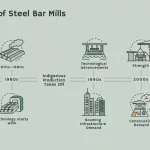
After 1947, Pakistan had very little steelmaking capacity. The first steel bar producers were mainly re-rolling mills that heated scrap and ship-breaking steel and rolled it into bars. Many were small, family-run units in Lahore, Karachi and Gujranwala. Over time, these mills became the backbone of construction steel supply.
Pakistan Steel Mills
Pakistan Steel Mills in Karachi, built with Soviet assistance and started in the 1970s, became the country’s only integrated steel plant, making iron and steel from ore. It began production in the early 1980s and was a major national industry for decades. However, it ran into financial and operational problems and has not been in regular production since around 2015.
The Rise of Modern Rebar Makers
From the 1980s onwards, private companies invested in melting shops, continuous casting and modern rolling mills. As a result, the industry moved from simple re-rolling to making its own billets from scrap in electric furnaces, then rolling them into tested, graded bars. Several large producers are now listed on the Pakistan Stock Exchange, and many are members of the Pakistan Association of Large Steel Producers (PALSP).
Kamran Steel Mills
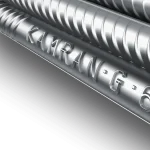
Kamran Steel installed its first facility in 1984. Today, Kamran Steel manufactures deformed reinforcement bars at its factory on Sheikhupura Road, Lahore, rolling them from its own steel billets. It produces Grade 40 and Grade 60 bars to ASTM A615 in sizes from 10 mm to 36 mm, and it is a member of PALSP.
- Corporate office: 13 KM Sheikhupura Road, Lahore
- Factory: 18 KM Sheikhupura Road, Lahore
- Sales office: 28-A Peco Road, Badami Bagh, Lahore · +92-42-3728 6582
How the Industry Looks Today
| Stage | Typical practice today |
| Raw material | Local and imported scrap, plus bought-in billets |
| Melting | Induction or electric arc furnaces |
| Casting | Continuous casting into billets |
| Rolling | Modern rolling mills with quenching (TMT) |
| Quality | Tensile, bend and chemical testing; mill test certificates |
For the full process, read the steel bar manufacturing process.
To see how the industry works today, read our guide to steel mills in Pakistan.
Challenges and the Road Ahead
The industry still faces high energy costs, dependence on imported scrap and competition from untested bars. Even so, demand from housing and infrastructure keeps growing. Read the Pakistan steel industry outlook for more.
Read more about our own history on the About Kamran Steel page. How a modern mill like ours works today is explained on the process page.
Check today’s Kamran Steel rate or contact our sales team.