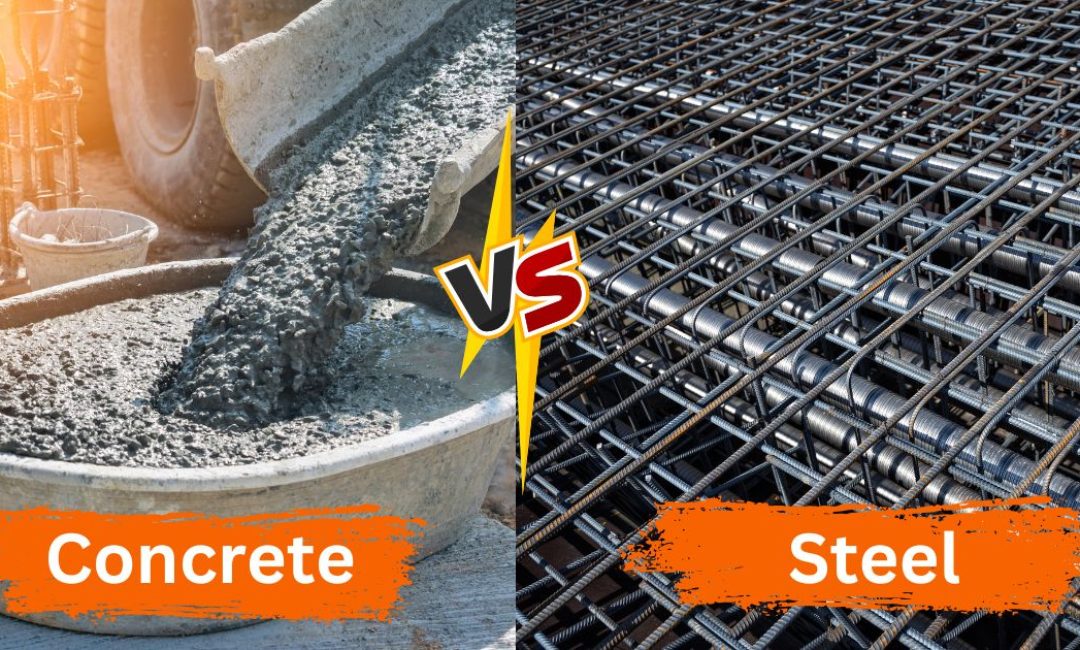
Concrete vs steel is a common question when people plan a house or a commercial building in Pakistan. The honest answer is that most buildings use both. Concrete is excellent at carrying compression, and steel is excellent at carrying tension, so together they make reinforced concrete (RCC). This guide compares the two materials, explains where each one works best, and shows what that means for your home.
Steel and Concrete: The Basics
Concrete is a mix of cement, sand, crushed stone and water. It hardens into a strong, heavy material that resists squeezing (compression) very well. However, it is weak when pulled or bent (tension) and can crack.
Steel is an alloy of iron and a little carbon. It is very strong in both tension and compression, and it bends before it breaks. In buildings, steel is used in two ways: as reinforcement bars inside concrete, and as structural steel sections (beams, columns and frames).
Concrete vs Steel: Side-by-Side Comparison
| Factor | Concrete | Steel |
| Compressive strength | Good (typically 20 to 40 MPa in buildings) | Very high |
| Tensile strength | Low (roughly one-tenth of its compressive strength) | Very high (Grade 60 rebar yields at 420 MPa) |
| Behaviour under overload | Brittle; cracks suddenly unless reinforced | Ductile; bends and gives warning |
| Weight | Heavy | Light for its strength |
| Fire resistance | Good on its own | Needs protection in fire (fire-rated coating or concrete cover) |
| Corrosion | Does not rust | Rusts if exposed; protected by concrete cover or coating |
| Speed of construction | Slower (formwork and curing) | Faster for prefabricated steel frames |
| Typical use in Pakistan | Foundations, columns, beams, slabs, walls | Rebar in RCC; warehouses, factories and long-span roofs |
Why Steel and Concrete Work Best Together
In reinforced concrete, the concrete carries compression while the steel bars carry tension. In addition, the two materials expand by almost the same amount when heated, so they move together without separating. The concrete also protects the steel from rust and fire. As a result, RCC is strong, durable, fire-resistant and affordable, which is why almost every house and plaza in Pakistan uses it.
Which Is Better for a House in Pakistan?
For a normal house, an RCC frame (concrete reinforced with steel bars) is usually the best choice:
- Local builders and labour know RCC well.
- Cement, sand, crush and steel bars are available everywhere.
- RCC keeps homes cooler than a bare steel structure in Pakistan’s hot climate.
- Properly designed RCC performs well in earthquakes.
A full structural steel frame makes more sense for warehouses, factories, sheds and buildings with very long spans, where speed and light weight matter more.
Earthquake Safety
Much of Pakistan is seismically active. In an earthquake, plain concrete can crack suddenly. By contrast, steel bars stretch and bend, holding the structure together and giving occupants time to get out. For this reason, earthquake-resistant RCC depends on good steel: the right grade (usually Grade 60), the correct bar sizes, proper ties and enough steel at joints. Always follow a qualified engineer’s design and the Building Code of Pakistan (Seismic Provisions).
Cost Considerations
In an RCC house, steel is one of the largest material costs, alongside cement. Therefore, it pays to buy the right quantity and a fair price. At today’s Kamran Steel rates, Grade 40 is Rs 275,000 per ton and Grade 60 is Rs 277,000 per ton, the same in every city with transport extra. To estimate your cost, use the steel rate calculator or see how much steel a 5, 7 or 10 marla house needs.
Tips for Using Steel and Concrete Well
- Use the concrete mix and cover specified in the drawings; cover protects the steel from rust.
- Buy tested, branded steel bars of the correct grade. See Grade 40 vs Grade 60 steel.
- Cure concrete properly with water for the recommended period.
- Store steel bars off the ground and covered until use.
Reinforcement Bars from Kamran Steel
Kamran Steel has manufactured deformed steel bars for RCC construction in Lahore since 1984. We supply Grade 40, Grade 60 and Grade 75 bars to ASTM A615 in sizes from 10 mm to 36 mm. Check today’s steel rate in Pakistan or contact our sales team.
Related reading: Types of Steel Bars · Different Grades of Steel Bars · Steel Myths in the Pakistani Market · The Importance of Reinforcement Bars in Modern Construction

Recent Comments