
The modern infrastructure is made of steel. It may be the frame of a tower, the columns of a bridge, or the support of a tunnel, but steel is the strong and durable component. Behind all powerful constructions, there is a path made of raw scrap metal and finished rebars that can resist the highest stress, strain and environmental impact.
This transformation is done precisely, innovatively, and with unremitting attention to quality at Kamran Steel. Through modern melting methods, refining techniques, automatic rolling machines and intense testing Kamran Steel maintains quality of all batches of rebars and billets to international standards including ASTM, BS, ISO, and PEC.
Step 1: Scrap should be carefully selected.
The process starts with the selection of scrap, which is a step that defines the starting point of steel quality. The scrap that Kamran Steel buys is graded and pre-screened, which means that any impurities such as rust, coatings, and undesirable materials are eliminated. Kamran Steel begins with the purest and strongest raw material as opposed to generic suppliers who start with mixed-quality scrap.
Advantage of Engineering: Ready to scrap means less defect, more uniform tensile and weld ability – very important in civil architecture such as bridges and dams.
Step 2: EAF Melting.
In current Electric Arc Furnaces (EAF), the chosen scrap is melted at temperatures above 1,600 C. In comparison with other types of furnaces, EAFs enable more strict control of the temperature and minimize carbon footprint. Sulfur, phosphorus and other impurities get extracted and the remaining is a refined molten steel.
Engineering Benefit: Stable chemistry means that steel rebars should act predictably under stress and strain.
Step 3: Refining and Alloying
The hot steel is loaded onto secondary refining and alloying. Certain ingredients such as carbon, manganese, chromium and vanadium are added to increase strength, ductility and corrosion resistance. The batches are tested in spectrometers to test alloy balance and quality consistency.
Engineering Benefit: Rebars designed with balanced alloys have high yield strength, bendability and weldability – suitable in earthquake prone areas and coastal buildings.
Step 4: Continuous Casting to Billets.
After smoothing, the steel is cast in continuous casting machines in the form of homogenous billets. The technique removes variations in manuals and makes billets uniform in size, shape and grain structure.
Engineering Benefit: Rebars with constant stress-strain behaviour are engineered on defect-free billets, providing engineers with confidence in the structural performance.
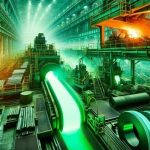
Step 5: Auto Rolling Mills.
The billets are heated once again and rolled in automated rolling mills to shape rebars of different diameters. In Kamran Steel Thermo-Mechanical treatment (TMT) technology is used to produce rebars that have hard outer coats and ductile inner cores.
Engineering Benefit: TMT rebars are both strong and flexible, which is vital in mega projects like CPEC highways, metro systems and hydropower dams.
Step 6: Controlled Cooling/Thermo-Mechanical Treatment.
Rebars are rolled in water-cooling systems that control the heat. This is so that steel does not harden and can still be bent and welded on site.
Engineering Benefit: High earthquake resistance, survival in adverse climate.
Step 7: Intensive Quality Testing.
Rebars produced by Kamran Steel are never released to the market without testing. The performance of the laboratories is checked by both in-house and third-party labs.
Tests Include:
- Tensile Strength Tests – to test maximum carrying capacity.
- Bend and Weld Tests- checking that rebars can be bent and welded on site without cracks.
- Chemical Composition Analysis – verification of alloy balance.
- Corrosion Resistance Tests- these tests are used to simulate severe situations such as coastal or hydropower projects.
This action instills confidence in engineers that all batches have been proven to be reliable.
Step 9: Certification and Packaging.
After a batch has successfully gone through all tests, rebars are packaged, marked and given official certifications of compliance. The certificates will assure the contractors and engineers that the steel is international.
The willingness to be certified is another aspect that makes Kamran Steel stand out among generic suppliers where documentation and traceability may be missing.
Table: Kamran Steel vs. Generic Steel Manufacturing
| Stage | Generic Steel Manufacturer | Kamran Steel Advantage |
| Scrap Selection | Mixed quality, unchecked | Graded, inspected scrap |
| Melting Technology | Basic furnaces | Electric Arc Furnace (EAF) |
| Refining & Alloying | Limited quality control | Lab-tested alloy balance |
| Billet Casting | Manual, inconsistent | Automated continuous casting |
| Rolling Process | Non-uniform rebars | TMT technology, uniform strength |
| Quality Testing | Minimal checks | Full tensile, bend, weld, corrosion tests |
| Certification | Often missing | Provided with every batch |
What is special about Kamran Steel Process?
Kamran Steel is not only a producer but also an ally to engineers and contractors who require consistent performance where it counts.
- Sustainability – Recycling scrap has a low environmental impact.
- Automation – Provides consistency and eliminates human error.
- Customization – Rebars may be made to meet special yield strength or ductility needs.
- globe Global Compliance – full ASTM, BS, ISO, PEC compliance.
Conclusion
The process of transforming scrap into high-performance rebars is a long, complicated and very controlled process. In Kamran Steel, there is no process (raw material, to high-level rolling, and rigorous testing) which does not contribute to ensuring uniformity, durability, and strength.
To engineers, contractors and developers, this translates to one thing, confidence. Assurance that each batch of rebars will deliver as promised, which will be safe, cost-efficient, and long-lasting structures.
Kamran Steel is not simply making steel, but it is defining the future of the infrastructure in Pakistan with consistency and creativity.
Recent Comments